
Fractions represent parts of a whole, and understanding their different forms is crucial for mathematical fluency.
Today’s date is 05/04/2026.
Worksheets focusing on improper fractions and mixed numbers
are available as PDFs, offering practice in converting between these forms.
What are Improper Fractions?
Improper fractions are a fascinating part of mathematics where the numerator – the top number – is greater than or equal to the denominator – the bottom number. This means the fraction represents a quantity that is one whole or more. For example, 7/3 is an improper fraction. Think of it as having more pieces than needed to make a complete whole!
Unlike proper fractions (where the numerator is smaller than the denominator), improper fractions often require conversion to a more understandable form, like a mixed number. Worksheets, often available as a PDF, provide excellent practice in identifying and working with these fractions. These resources help students grasp the concept of quantities exceeding a single unit. Understanding improper fractions is a foundational step towards mastering more complex fraction operations, and a solid grasp is essential for success in algebra and beyond.
Converting between improper fractions and mixed numbers is a key skill reinforced through practice problems found in these worksheets.
What are Mixed Numbers?
Mixed numbers offer a more intuitive way to represent quantities greater than one. They consist of a whole number and a proper fraction combined. For instance, instead of writing 7/3, we can express it as 2 1/3 – meaning two whole units and one-third of another unit. This format is often easier to visualize and understand in real-world scenarios.
PDF worksheets dedicated to mixed numbers and improper fractions frequently emphasize converting between these two forms. These exercises help students build a strong conceptual understanding of how they relate to each other. Mastering mixed numbers is crucial for applications in areas like cooking, measurement, and construction, where dealing with partial quantities is common.
The ability to seamlessly switch between improper fractions and mixed numbers demonstrates a comprehensive grasp of fractional concepts, a skill honed through consistent practice using these readily available resources.
Converting Improper Fractions to Mixed Numbers
Converting involves dividing the numerator by the denominator, obtaining a whole number and a remainder; PDF worksheets
provide ample practice with this essential skill.
The Division Method Explained
The core of converting an improper fraction to a mixed number lies in division. Essentially, you’re determining how many whole groups can be formed from the numerator using the denominator as the group size. For instance, with 7/3, you ask: how many times does 3 fit into 7? The answer, 2, becomes the whole number part of your mixed number.
The remainder from this division is then crucial. In the 7/3 example, 3 goes into 7 twice (6), leaving a remainder of 1. This remainder becomes the new numerator, and the original denominator stays the same. Therefore, 7/3 converts to 2 1/3.
PDF worksheets often emphasize this process, providing numerous problems to practice the division step. Mastering this method is fundamental for understanding fraction relationships and performing further operations. Resources like Study.com detail these steps, and practice platforms like IXL offer interactive exercises to solidify understanding.
Step-by-Step Guide to Conversion
Converting improper fractions to mixed numbers involves a clear, sequential process. First, divide the numerator by the denominator – this is the foundational step, as highlighted by resources like Study.com and the University of Arkansas Learning Blocks. Note the whole number result and any remainder.
Second, the whole number from the division becomes the whole number part of the mixed number. Third, the remainder becomes the new numerator, while the original denominator remains unchanged. Combine these to form the fractional part of the mixed number.
Worksheet practice is vital. PDF worksheets provide structured exercises, starting with simpler fractions and progressing to more complex ones. Consistent practice reinforces this process, building confidence and accuracy. Remember to always double-check your work, ensuring the fractional part is in its simplest form.
Example 1: Converting 7/3 to a Mixed Number
Let’s illustrate the conversion process with the improper fraction 7/3. Following the established method, we divide the numerator (7) by the denominator (3). This division yields a whole number of 2, with a remainder of 1. This aligns with the guidance from Study.com and the University of Arkansas Learning Blocks.
Now, we construct the mixed number. The whole number, 2, becomes the whole number part. The remainder, 1, becomes the new numerator, and we retain the original denominator, 3. Therefore, 7/3 is equivalent to the mixed number 2 1/3.
Worksheet exercises often include similar examples, allowing students to practice this conversion independently. Regularly working through these problems, found in PDF format, solidifies understanding and builds proficiency. Remember to verify your answer!
Example 2: Converting 11/4 to a Mixed Number
Let’s convert the improper fraction 11/4 into a mixed number, applying the same division method. We divide the numerator (11) by the denominator (4). This results in a whole number quotient of 2, and a remainder of 3. This process mirrors the explanations found on Study.com and within University of Arkansas Learning Blocks resources.
To form the mixed number, we use the whole number (2) as the whole number part. The remainder (3) becomes the new numerator, while the original denominator (4) remains unchanged. Consequently, 11/4 is equivalent to the mixed number 2 3/4.
Practice worksheets, often available as PDFs, present numerous problems like this, reinforcing the conversion skill. Consistent practice, utilizing these resources, is key to mastering improper fractions and mixed numbers. Don’t forget to double-check your work!
Converting Mixed Numbers to Improper Fractions
Converting from mixed numbers to improper fractions involves multiplying, adding, and keeping the original denominator.
PDF worksheets provide ample practice for this skill, enhancing understanding.
Understanding the Process
Converting a mixed number – a whole number combined with a proper fraction – into an improper fraction requires a systematic approach. The core idea is to represent the mixed number as a single fraction where the numerator is greater than the denominator. This process begins by recognizing that the whole number portion represents a number of whole units, each consisting of the same number of parts as defined by the denominator of the fractional part.
To begin, multiply the whole number by the denominator of the fraction. This result represents the total number of fractional parts from the whole number portion. Next, add this product to the numerator of the original fraction. This sum becomes the new numerator of the improper fraction. Crucially, the denominator remains unchanged throughout this conversion.
PDF worksheets dedicated to mixed numbers and improper fractions offer structured exercises to solidify this understanding. These resources often present problems with varying difficulty levels, allowing learners to progressively build their skills. Mastering this conversion is fundamental for performing arithmetic operations with fractions effectively.
Multiplying and Adding: The Key Steps
The conversion from a mixed number to an improper fraction hinges on two fundamental arithmetic operations: multiplication and addition. First, you must multiply the whole number component of the mixed number by the denominator of its fractional part. This step determines the equivalent number of fractional units contained within the whole number portion.
Following multiplication, add the result to the original numerator of the fraction. This sum represents the total number of parts in the improper fraction. Remember, the denominator remains constant throughout the process, defining the size of each individual part. The resulting fraction, with a numerator greater than or equal to the denominator, is the improper fraction equivalent.
Worksheet PDFs focused on these conversions provide ample practice. They often include step-by-step examples and progressively challenging problems. Consistent practice with these key steps ensures a solid grasp of this essential fraction manipulation skill.
Example 1: Converting 2 1/3 to an Improper Fraction
Let’s demonstrate the conversion process with the mixed number 2 1/3. First, multiply the whole number (2) by the denominator (3): 2 * 3 = 6. This tells us there are six thirds within the whole number portion of the mixed number.
Next, add this result (6) to the original numerator (1): 6 + 1 = 7. This sum, 7, becomes the new numerator of our improper fraction. The denominator remains unchanged at 3.
Therefore, the improper fraction equivalent of 2 1/3 is 7/3. Worksheet PDFs often present similar examples, guiding students through each step. Mastering this process is vital for further fraction operations. Practice with various mixed numbers reinforces understanding and builds confidence. Remember to always double-check your multiplication and addition!
Example 2: Converting 3 2/5 to an Improper Fraction
Now, let’s convert the mixed number 3 2/5 into an improper fraction, mirroring the previous method. Begin by multiplying the whole number (3) by the denominator (5): 3 * 5 = 15. This represents the number of fifths contained within the whole number part.
Subsequently, add this product (15) to the original numerator (2): 15 + 2 = 17. This sum, 17, will serve as the new numerator for our improper fraction. Crucially, the denominator remains constant at 5.
Consequently, the improper fraction equivalent of 3 2/5 is 17/5. Many worksheets, often available as PDFs, utilize this technique. Consistent practice with these conversions solidifies comprehension. Remember, accurate multiplication and addition are key to success. These exercises prepare students for more complex fraction manipulations.

Worksheet Focus: Practice and Application
PDF worksheets provide targeted practice converting between improper fractions and mixed numbers, with varying difficulty levels—easy, medium, and hard—to reinforce learning.
Types of Problems on a Worksheet
Worksheets dedicated to improper fractions and mixed numbers typically present a variety of problem types designed to build a comprehensive understanding. A core component involves converting improper fractions – where the numerator is greater than or equal to the denominator – into their equivalent mixed number form, consisting of a whole number and a proper fraction.
Conversely, students practice transforming mixed numbers back into improper fractions. These worksheets often include problems requiring simplification of the resulting fractions, ensuring students grasp the concept of reducing fractions to their lowest terms. Some worksheets introduce visual aids, like diagrams, to help students conceptualize the conversions.

More advanced worksheets may incorporate word problems that require students to apply their knowledge of improper fractions and mixed numbers to real-world scenarios, such as measuring ingredients in a recipe or calculating lengths in construction. The availability of these resources as PDFs allows for easy printing and offline practice.
Difficulty Levels: Easy, Medium, Hard
Mixed numbers and improper fractions worksheet PDFs are commonly structured with varying difficulty levels to cater to diverse learning needs. Easy level worksheets focus on basic conversions with smaller numbers and often provide visual models to aid understanding. These typically involve straightforward division and remainder application.
Medium level worksheets introduce larger numbers, requiring students to perform more complex division and potentially simplify resulting fractions. Visual aids are less frequent, encouraging independent problem-solving. The hard level presents the most challenging problems, often including multiple conversions in a single question, fractions requiring significant simplification, or word problems demanding application of the concepts.
These levels allow for progressive skill development, ensuring students master each concept before moving on. The PDF format allows educators to easily select appropriate worksheets based on student proficiency.
Benefits of Using a PDF Worksheet
Mixed numbers and improper fractions worksheet PDFs offer numerous advantages for both educators and students. PDF format ensures consistent formatting across all devices, eliminating display issues. They are easily printable, allowing for tangible practice away from screens – crucial for kinesthetic learners.
Worksheets provide focused practice, reinforcing concepts learned in class. The downloadable nature of PDFs allows for convenient access and storage, creating a readily available resource library. Many PDF worksheets include answer keys, facilitating self-assessment and independent learning.
Furthermore, PDFs are often free or low-cost, making them an accessible learning tool. They support differentiated instruction, as teachers can select specific exercises based on individual student needs. This format is ideal for homework, review, or in-class assignments.
Common Mistakes to Avoid
When completing worksheets, students often make errors with division or forget to simplify answers.
Careless multiplication and addition also lead to inaccuracies; review carefully!
Incorrect Division
A frequent error when converting improper fractions to mixed numbers, or vice versa, involves inaccurate division. Students might miscalculate the quotient when dividing the numerator by the denominator. For example, when converting 7/3, failing to recognize that 3 goes into 7 twice with a remainder of 1 leads to an incorrect whole number component.
Conversely, when converting from a mixed number like 2 1/3 to an improper fraction, incorrect multiplication and addition can occur. Forgetting to multiply the whole number (2) by the denominator (3) before adding the numerator (1) results in a wrong numerator for the improper fraction.
Worksheet practice helps solidify the division process, but careful attention to detail is essential. Double-checking the quotient and remainder is crucial for accurate conversions. Utilizing resources like IXL or Study.com can provide additional practice and identify areas needing improvement.
Forgetting to Simplify
A common oversight when working with fractions, including those derived from improper fraction to mixed number conversions, is failing to simplify the resulting fraction. After obtaining the fractional part of a mixed number (the remainder over the original denominator), students sometimes neglect to check if this fraction can be reduced to its simplest form.
For instance, if converting an improper fraction results in a mixed number with a fractional component like 4/2, it must be simplified to 2/1 or simply 2. Similarly, when converting a mixed number to an improper fraction, the resulting improper fraction should be checked for simplification.
PDF worksheets often include problems designed to reinforce simplification. Regularly practicing simplification techniques alongside conversion exercises is vital. Resources like University of Arkansas Learning Blocks can aid in mastering this skill, ensuring accurate and concise fractional representations.
Errors in Multiplication and Addition
Converting mixed numbers to improper fractions relies heavily on accurate multiplication and addition. A frequent error occurs when students incorrectly multiply the whole number by the denominator. For example, with 2 1/3, failing to correctly multiply 2 by 3 leads to an incorrect numerator in the subsequent addition step.
Similarly, errors can arise during the addition of the numerator and the product from the multiplication. A simple miscalculation here throws off the entire conversion. PDF worksheets often present numerous practice problems, but students must focus on methodical execution of these operations.
Resources like IXL and Study.com offer targeted practice to strengthen these foundational skills. Careful attention to detail and double-checking calculations are crucial for avoiding these common mistakes when working through conversion exercises.

Resources for Further Learning
Online platforms like IXL provide extensive practice converting between improper fractions and mixed numbers.
Study.com offers lessons, and University of Arkansas Learning Blocks
aid understanding, complementing PDF worksheet practice.
Online Practice Platforms (IXL)
IXL offers a comprehensive suite of interactive exercises specifically designed to bolster skills in converting between improper fractions and mixed numbers. Available for both 5th and 6th grade math levels, IXL provides personalized learning paths, adapting to the student’s individual needs and pace. The platform delivers immediate feedback, highlighting areas of strength and pinpointing concepts requiring further attention.
Beyond simple conversion, IXL’s practice problems often integrate these concepts into broader mathematical contexts, fostering a deeper understanding of fraction operations. Students can track their progress, earning rewards and badges as they master new skills. This gamified approach enhances engagement and motivation. While a subscription is required for full access, the benefits of consistent practice on IXL can significantly improve a student’s proficiency with improper fractions and mixed numbers, supplementing PDF worksheet exercises.
IXL’s detailed reporting features also allow teachers and parents to monitor student performance and identify areas where additional support may be needed.
Study.com Lessons
Study.com provides structured video lessons and accompanying practice quizzes focused on mastering the conversion between improper fractions and mixed numbers. These lessons break down the process into easily digestible steps, often visually demonstrating the techniques involved. The platform emphasizes a clear understanding of the underlying principles, rather than rote memorization of procedures.
Study.com’s content aligns with common core standards, making it a valuable resource for students seeking to reinforce classroom learning or prepare for standardized tests. The lessons often include real-world examples, illustrating the practical applications of these mathematical concepts. Supplementing practice with a PDF worksheet can solidify understanding;
Furthermore, Study.com offers detailed explanations of common mistakes and provides strategies for avoiding them. The platform’s comprehensive approach caters to diverse learning styles, offering a flexible and accessible learning experience.
University of Arkansas Learning Blocks
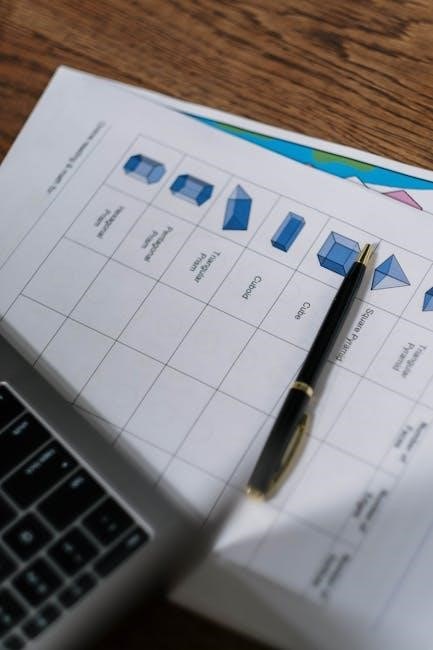
University of Arkansas Learning Blocks offers concise, focused modules designed to build foundational math skills, including the conversion between improper fractions and mixed numbers. Their approach centers on clear explanations and step-by-step demonstrations, making complex concepts more approachable. The resources emphasize the core process: dividing the numerator by the denominator to facilitate conversion.
These Learning Blocks are particularly useful for students needing targeted practice in specific areas. They provide a solid base for tackling more advanced fraction operations. Utilizing a PDF worksheet alongside these modules allows for independent practice and assessment of comprehension.
The platform’s materials are freely accessible, making them a valuable resource for educators and learners alike. They promote a deeper understanding of fraction equivalence and the relationship between improper fractions and mixed numbers.

Real-World Applications
Fractions appear in everyday life, from cooking measurements to construction projects.
Practicing conversions with a PDF worksheet builds practical skills for real-world problem-solving.
Cooking and Baking
Cooking and baking frequently involve fractions, making understanding mixed numbers and improper fractions essential skills in the kitchen. Recipes often call for quantities like 1 ½ cups of flour or ¾ teaspoon of vanilla. Being able to quickly convert between these forms ensures accurate measurements and successful results.
For instance, if a recipe requires 2 ¼ cups of sugar, understanding this as a mixed number is helpful. However, when scaling a recipe, converting to an improper fraction (like 9/4) can simplify calculations. A mixed numbers and improper fractions worksheet PDF provides targeted practice for these conversions.
Mastering these concepts prevents errors that could ruin a dish. Furthermore, understanding fractions aids in adjusting recipes – doubling or halving ingredients requires a solid grasp of fractional arithmetic. Therefore, proficiency with fractions isn’t just mathematical; it’s a valuable life skill for any aspiring cook or baker!
Measurement and Construction
Measurement and construction rely heavily on precise fractional values, making proficiency with mixed numbers and improper fractions critical. Whether measuring lumber for a building project or determining dimensions for a design, accurate fractional representation is paramount.
For example, a carpenter might need to cut a board to a length of 6 ½ inches. Understanding this as a mixed number is intuitive, but calculations involving multiple pieces often benefit from converting to an improper fraction (13/2). A mixed numbers and improper fractions worksheet PDF offers focused practice in these conversions.
In construction, even small errors in measurement can lead to significant problems. Similarly, in fields like engineering and architecture, precise fractional calculations are essential for structural integrity. Therefore, mastering these concepts isn’t merely academic; it’s fundamental to practical applications and successful project completion.